

StatOasis Research series, Volume 1
We tested 40 ways to buy the dip. 16 held up.36 Ways to Buy the Dip, Second Edition
The first volume of the StatOasis Research series: a 372-page research package that tests 40 mean reversion entries on SPY back to 1993 and on the E-mini S&P 500 futures back to 2007: 17,385 trades, and 2,880 backtested variants on each market. It builds 3 example strategies from the entries that held up, and ships full source code for all 40.
- 40
- entries, each tested at 8 holding periods
- 2,880
- backtested variants on each market
- 2
- instruments: SPY from 1993, ES futures from 2007
- 3
- example strategies with exact rules

By Ali Casey, founder of StatOasis. Systematic trader since 1998.
Every update and correction to the second edition is free.
Most buy-the-dip signals have never been tested against the one thing that matters
An entry is a claim: the next few bars after it are different from any other few bars. That claim has a test, and almost nobody runs it.
This book runs it on all 40. Every entry is measured against what a random entry, held just as long, already paid. The difference is the edge. 35 of the 37 ranked entries beat that baseline.
That's the easy finding. The hard ones are why the book is 372 pages.
Most top-ranked entries did not hold up.
SPY's 33.5 years were cut into three equal periods. 6 of the top 10 entries by rank failed that test.
Sixteen of the 40 held up across all three periods.
Eleven are worth less than half what they used to be. Ten are not reliably positive at all.
Some entries are the same trade in different clothes.
All 780 pairs of entries were checked for firing on the same days, so you know which ones add nothing.
They work on equity indices, not everywhere.
On the Nasdaq 100, the Dow and the Russell 2000, 84% to 96% of entries beat drift. On gold, they fail.
Look inside
Read a full entry before you buy
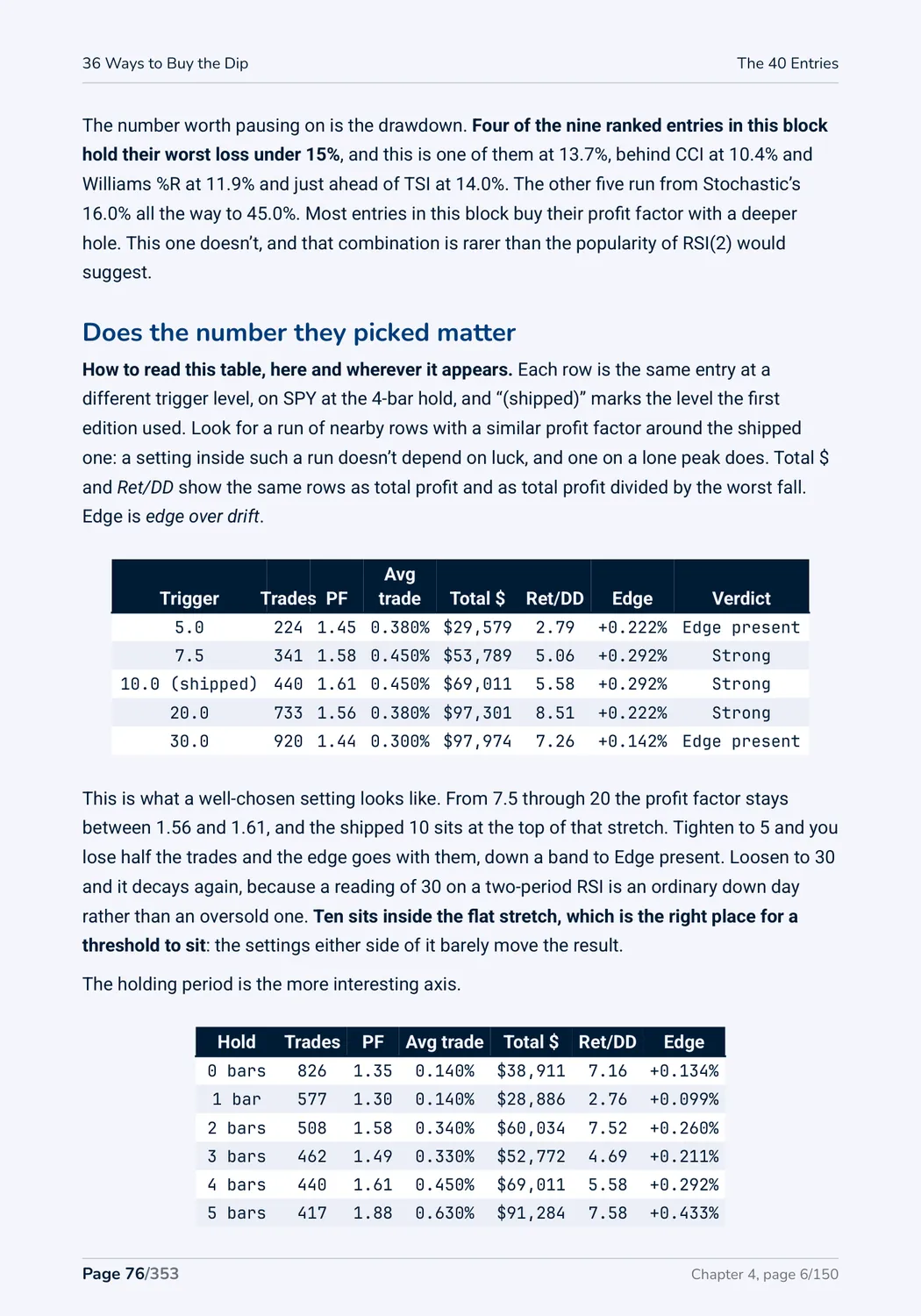
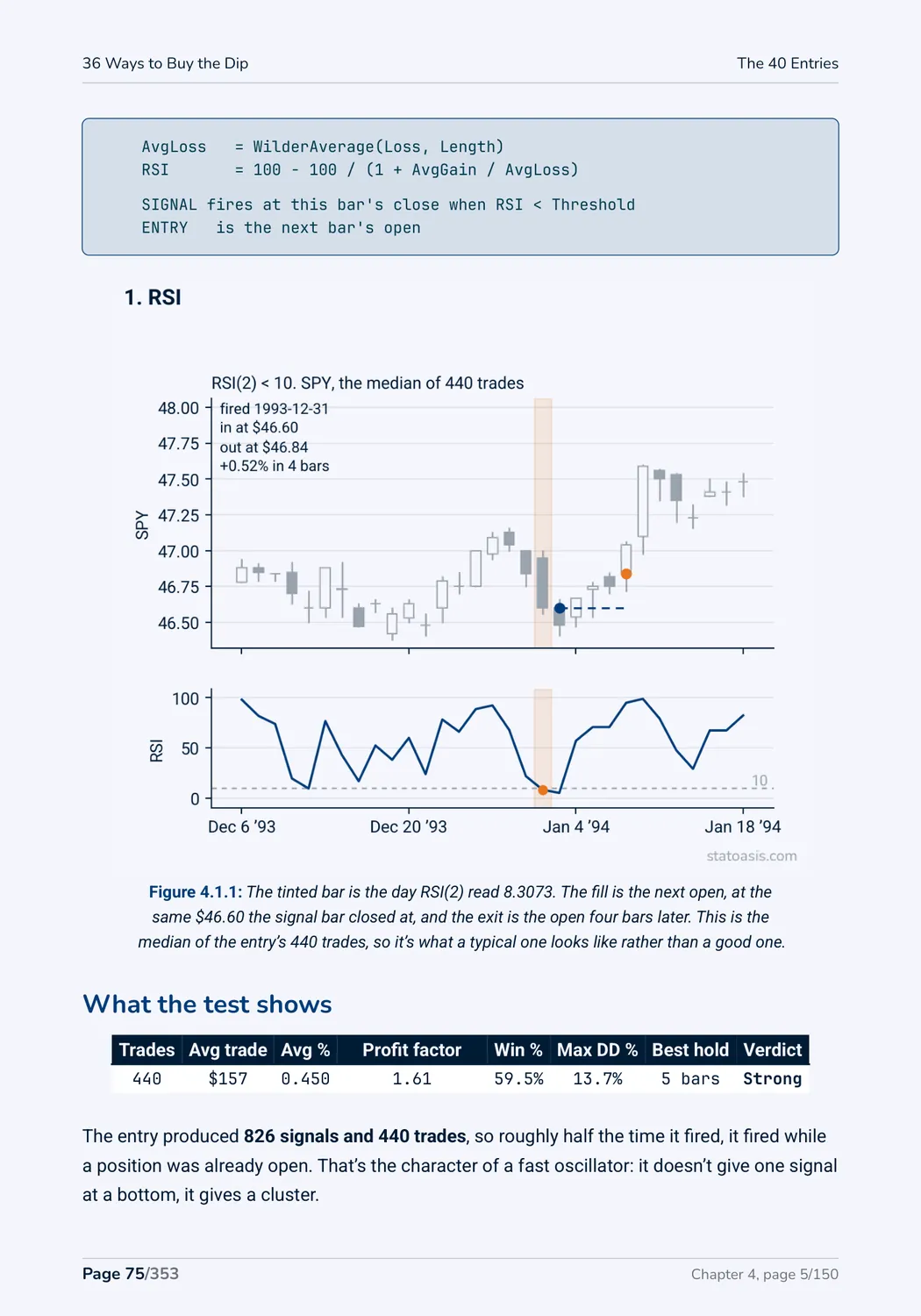
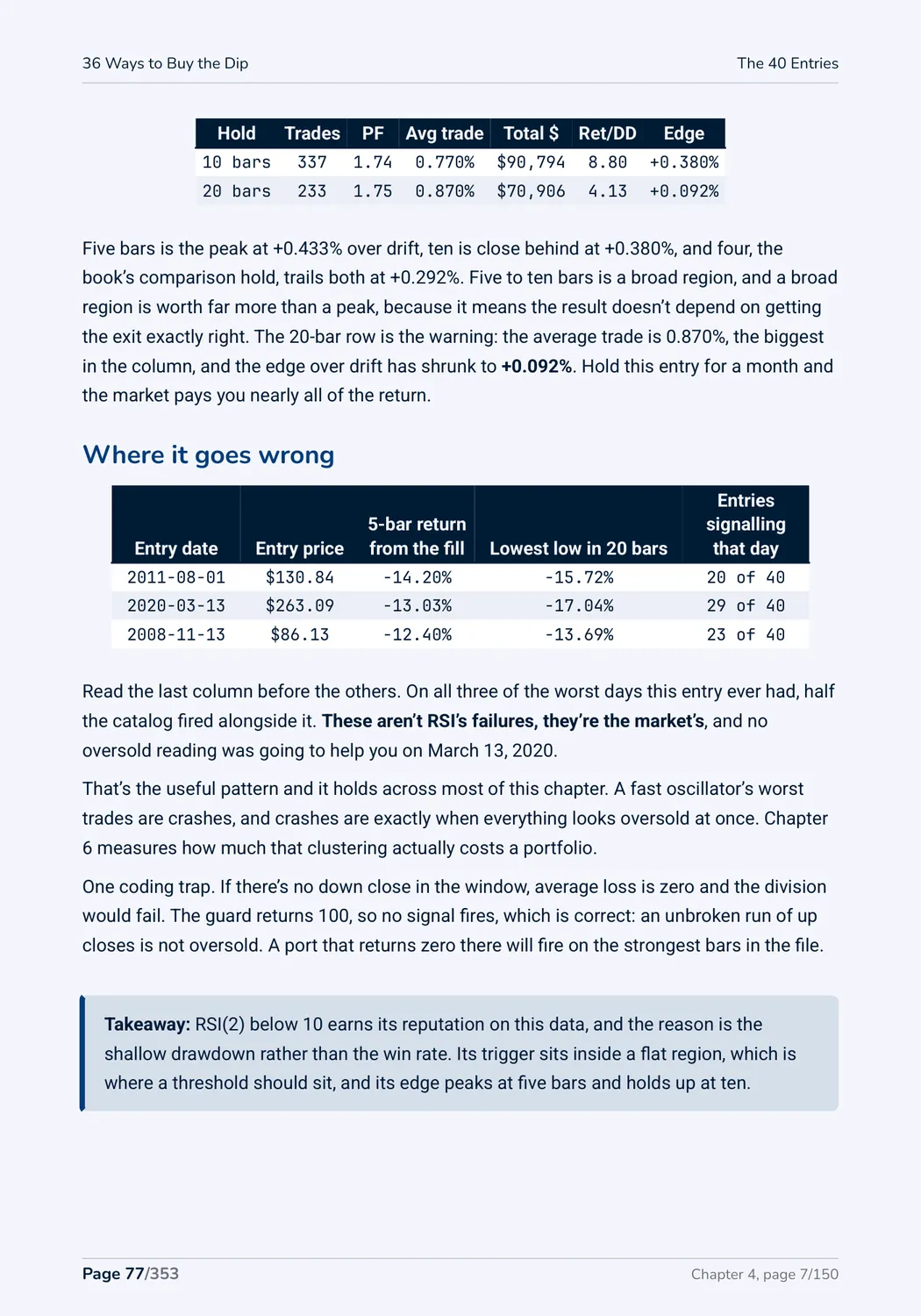
Entry 4.1, RSI(2) below 10, as the book prints it: the rule, a real median trade on its chart, the results, the threshold test, the holding periods and the three worst days. Every one of the 40 entries gets the same pages in the same order.
Read the RSI(2) full entry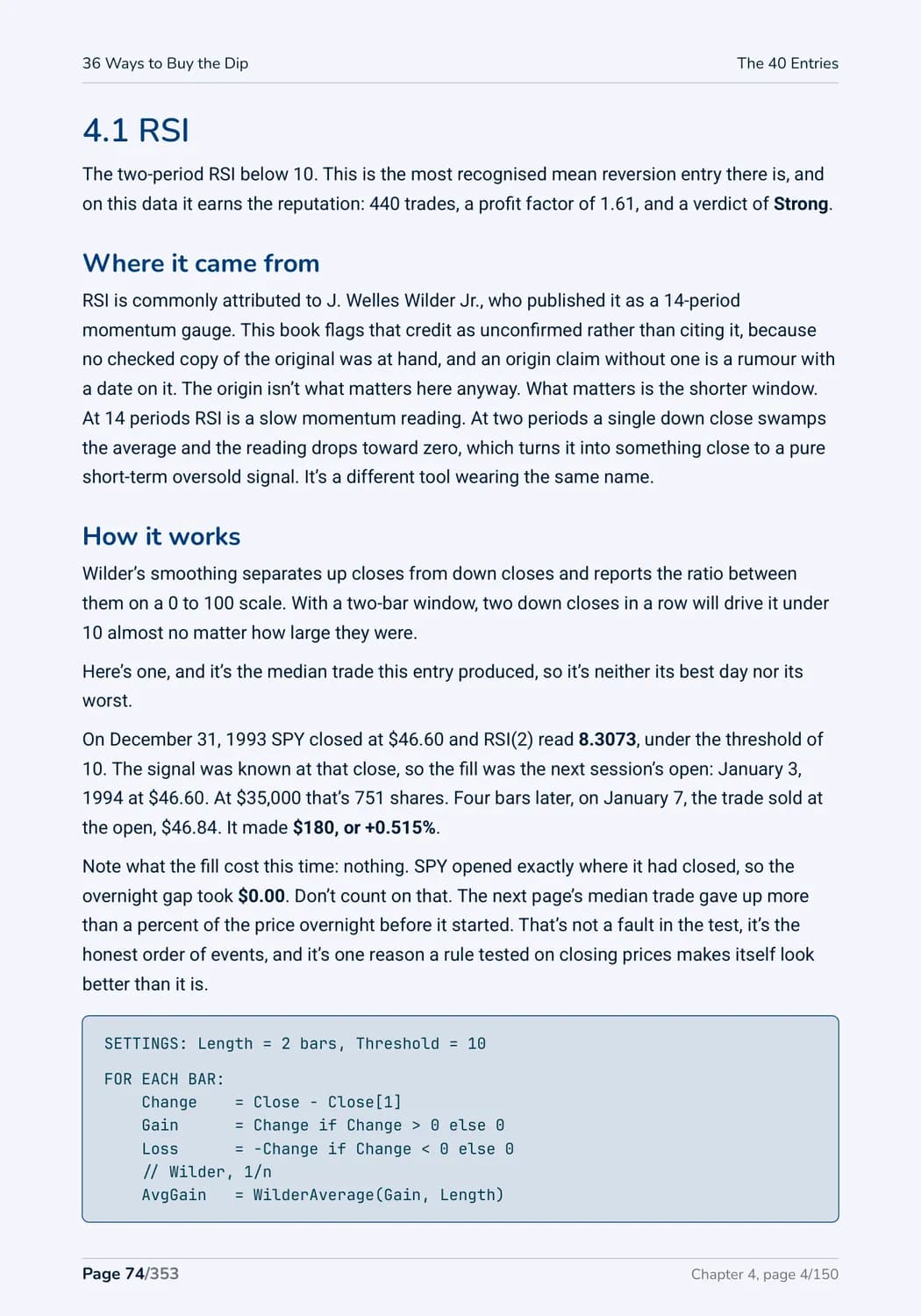
Part 1: The Playbook
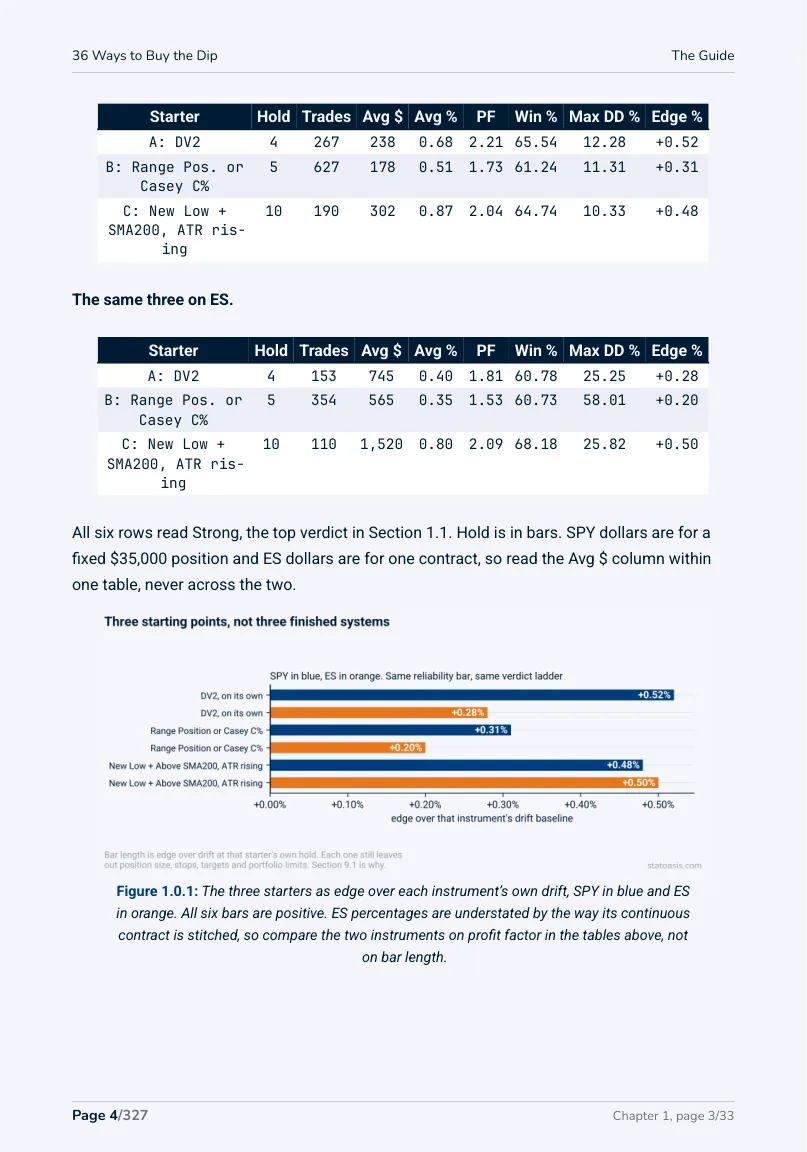
Three example strategies, built only from the eight entries that held up in all three periods and cleared the book's quality floor, and picked by rules written down before any result was read. Each comes with exact rules, a real trade on a chart, results on SPY and ES, and every variation by holding period and filter.
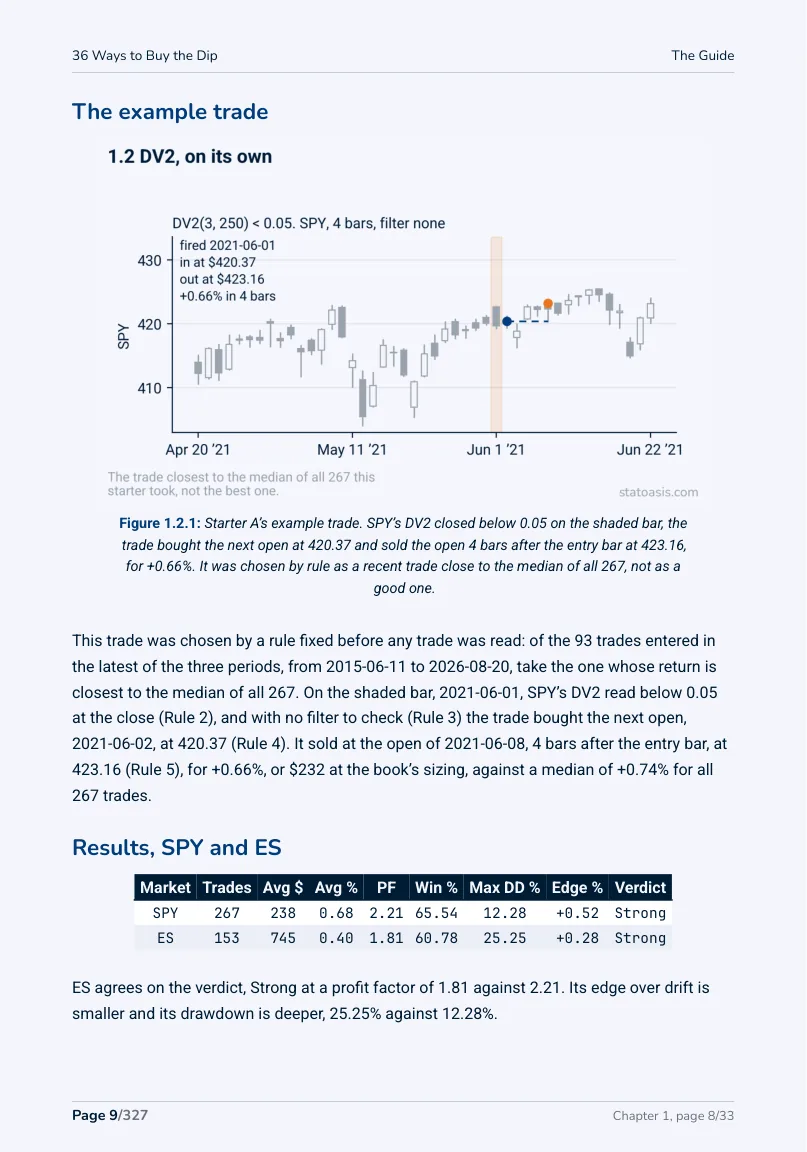
Example A: DV2 below 0.05, hold 4 days
- Market
- SPY
- Edge
- +0.52%
- Trades
- 267
- Profit factor
- 2.21
- Win %
- 65.54%
- Max drawdown
- 12.28%
- Market
- ES
- Edge
- +0.28%
- Trades
- 153
- Profit factor
- 1.81
- Win %
- 60.78%
- Max drawdown
- 25.25%
Example B: Range Position or Casey C%, hold 5 days
- Market
- SPY
- Edge
- +0.31%
- Trades
- 627
- Profit factor
- 1.73
- Win %
- 61.24%
- Max drawdown
- 11.31%
- Market
- ES
- Edge
- +0.20%
- Trades
- 354
- Profit factor
- 1.53
- Win %
- 60.73%
- Max drawdown
- 58.01%
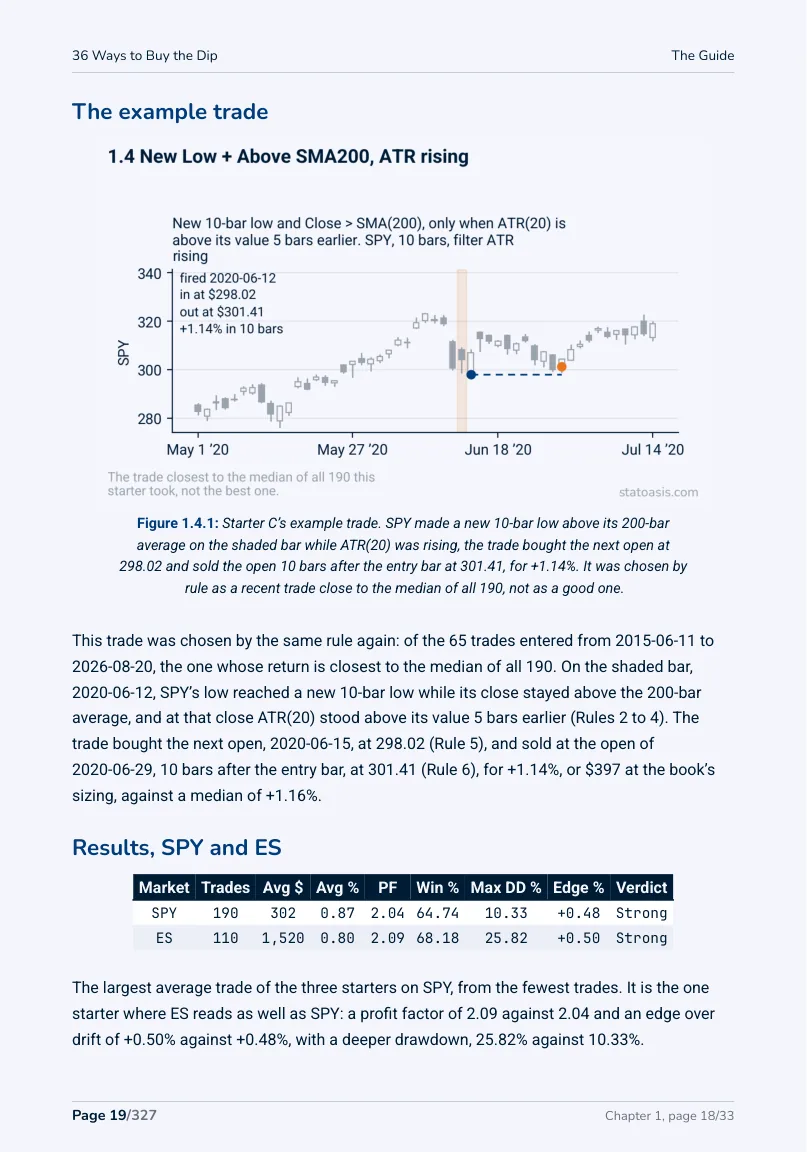
Example C: New 10-day low above the 200-day average, while ATR is rising, hold 10 days
- Market
- SPY
- Edge
- +0.48%
- Trades
- 190
- Profit factor
- 2.04
- Win %
- 64.74%
- Max drawdown
- 10.33%
- Market
- ES
- Edge
- +0.50%
- Trades
- 110
- Profit factor
- 2.09
- Win %
- 68.18%
- Max drawdown
- 25.82%
The book is straight with you about them: an example strategy is an entry, a hold and, for one, a filter. No stop, no position size, no portfolio rules. The Guide tells you what to decide before you trade one, and gives you the trade counts your own code must reproduce.
The three example strategies, the evidence on all 40 entries, and the code to check every result yourself.
Get the full package for $147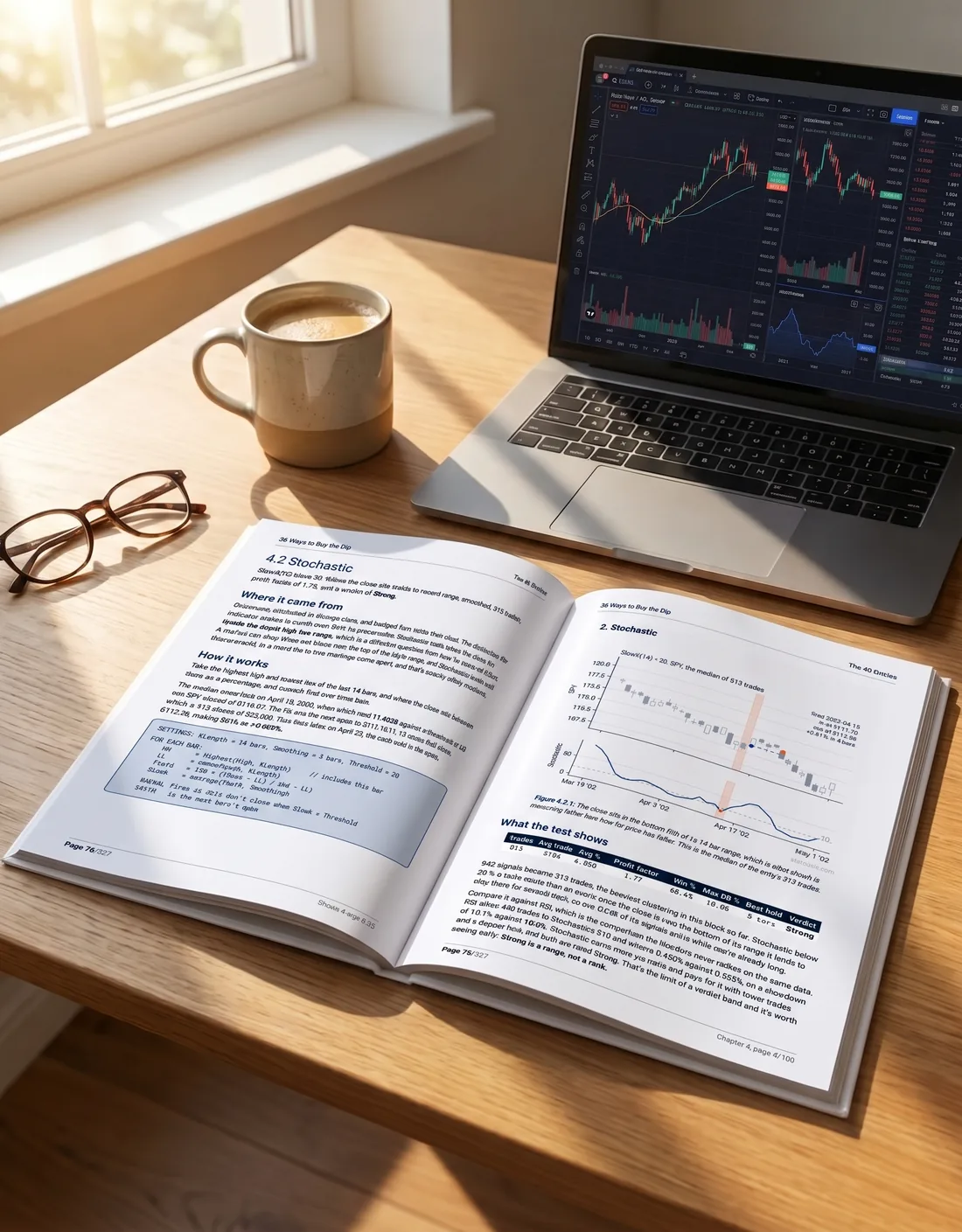
Part 2: The Evidence
All 40 entries
One page each: the rule, pseudo-code, results at 8 holding periods, a verdict, and what failed printed beside what worked.
The ranking, and why it is not the point.
How the 40 rank, and why the rank alone would have misled you.
Does the edge hold up?
Every entry across three equal periods of history, every regime filter across the same split, and every pair checked for overlap.
The same 40 on futures.
All 40 on the E-mini S&P 500 day session over 19.6 years, including what a back-adjusted continuous contract does to eight of them.
The same 40 on other markets.
Seven more markets and a control: the Nasdaq 100, the Dow, the Russell 2000, the 10-year note, the euro, gold and wheat.
From entry to strategy.
The four things an entry does not decide for you: the exit, the size, the risk per trade and the portfolio.
The code
Full source code included, for your own research and trading.
EasyLanguage for TradeStation
Ready-to-run code for all 40 entries.
Python
A standalone pack that computes all 40 entries and matches the book's own calculation on SPY and ES, signal for signal.
The 3 example strategies as ready-to-run code
In EasyLanguage and Python, reproducing the trade counts the book prints.
The AI entries file
All 40 rules, their pseudo-code and the 3 example strategies' rules in one plain text file. Hand it to an AI coding assistant with the book's PDF and have it write any entry or example strategy in your own platform's language. Appendix D shows how, and how to check what it writes before you trade it.
Every rule on the page
Pseudo-code on every entry page, and all 40 stated exactly in Appendix C.
What the first readers said
Every reviewer here received the book free for an honest review, and gets the next StatOasis book free for answering our questions. Each is shown as written, with the reader's own description of their trading as its caption.
How everything was tested
These are hypothetical results from historical backtests, not real trading, and they deduct no trading costs. Past results, real or hypothetical, are not a guarantee of future returns.
- Data
- SPY daily, 8,445 bars from 1993. The E-mini S&P 500 day session, 4,947 bars from 2007.
- Signal and fill
- The signal is read at the close; the trade buys the next open.
- Exit
- Execution rule v2. The open a fixed number of bars after the entry bar, at 1, 2, 3, 4, 5, 10 and 20 bars, with the sell order placed at the close of the bar before. A 0-bar hold sells the same day's close.
- Size
- Every SPY trade buys what $35,000 buys at the entry price; every ES trade is one contract. Nothing compounds, so the 40 are comparable.
- Positions and costs
- One position at a time, long only, and a signal during an open trade is skipped, including one on the bar the sell order is placed. Costs are frictionless, and the book says so on every results page, with the average trade that costs would eat.
Who it is not for
- Not for you if you want a signal service.There are no alerts. You code the rules or you don't use them.
- Not for you if you trade intraday.Everything is tested on daily bars.
- Not for you if you want a finished system.You get tested entries and three example strategies. The stop, the size and the portfolio are yours to decide, and the book shows you what to weigh.
- Not for you if you want the one best entry.The book's whole argument is that the best-ranked entry is usually not the one that lasts.

Who put this together?
I'm Ali Casey, founder of StatOasis and a systematic trader since 1998.
I wrote this because I wanted one place where every buy-the-dip entry is tested the same way, on real data, with the code to check it yourself. I couldn't find it, so I built it.
You won't only read about winners. Most top-ranked entries did not hold up, and the book says so.
So I built it myself. Now it's yours.
“Trade what works. Test everything. Trust the data.”
What you get
One download, licensed to you by name: the 372-page book, the code that reproduces its numbers, and everything to run it.
Part 1: the Playbook, a full chapter for beginners: the 3 example strategies with exact rules.
Part 2: all the research and the numbers behind it, for the researchers.
17,385 trades, and 2,880 backtested variants on each market: SPY from 1993, ES futures from 2007.
Ready-to-run code in EasyLanguage and Python for all 40 entries and the 3 example strategies, with install and run guides.
The AI companion: a mini book of all 40 rules, written to be read by AI models, so an AI assistant can write any entry in your own platform's language.
Free updates: every update and correction to the second edition is free.
Inside the download
- 36-Ways-to-Buy-the-Dip.pdfThe book
- 36-Ways-to-Buy-the-Dip-Code-v1.4.0/The code pack
- START HERE.txt
- 01 Install and Run Guide.pdf
- 02 AI Prompt Companion.pdf
- AI entries file/The AI companion: all 40 rules, for an AI assistant
- EasyLanguage/For TradeStation, with the 3 example strategies
- Python/Standalone pack, with the 3 example strategies
- Entries spreadsheet/All 40 entries and their results in one sheet, as Excel and CSV
- LICENSE.txt
Secure checkout
Payment is handled by Stripe over an encrypted connection. Your card details go straight to Stripe and never reach StatOasis.




The price$147, one payment.
Get the full packageFound a bug in the code? It is fixed free, and every buyer gets the fixed version.
All sales are final. This is a digital product and the book and code are available to download immediately, so there are no refunds. This does not affect your legal rights if a download is faulty or not as described.
Frequently asked questions
Value and price
How much is it?
$147, one payment. Every update to the second edition is free.
Can I find this for free online?
Some of it. One full entry, RSI(2), is free to read on this site, and the free study covers the ranking of the entries. What you won't find in one place is all 40 entries tested the same way, the stability tests across three periods, the futures and seven other markets, the three example strategies with exact rules, and code that reproduces the book's numbers.
Why pay when there are free videos on RSI and Stochastics?
Those are two entries out of 40. Videos describe an entry; they don't measure it against a random entry held just as long, or show whether it held up in all three periods. Sixteen of the 40 did.
The package
Is this a book or a course?
Neither, quite. It is the first volume of the StatOasis Research series: a research package with the rules, the results and the code, built to be tested rather than just read.
What exactly do I get when I pay?
One download: the 372-page PDF, the code pack (EasyLanguage for TradeStation, a standalone Python pack, the 3 example strategies as code), the AI entries file, an install and run guide and an AI prompt companion. Your copy is licensed to you by name.
Is it strategies or entries?
Both, and the book keeps them apart. It tests 40 entries, the signal that opens a trade, and builds 3 complete example strategies from the ones that held up. The example strategies have exact rules and a fixed exit. None of them carries a stop or a position size.
Does it include code?
Yes. Ready-to-run EasyLanguage and Python for all 40 entries and the 3 example strategies, plus an AI entries file of every rule, which with the book's PDF lets an AI assistant write any entry or example strategy in your own platform's language.
What format is it?
A 372-page PDF, with the code and the AI entries file in the same download.
Is there a printed copy?
No. It is a digital download only, and nothing is shipped.
Does it show results for every entry?
Yes. All 40 entries get a page each: the rule, pseudo-code, results at 8 holding periods, a verdict, and what failed printed beside what worked.
Platform and code
Which markets and dates were tested?
SPY daily from 1993, the E-mini S&P 500 futures from 2007, then seven more markets and a control.
Do I need special software?
The EasyLanguage runs on TradeStation, and the Python pack runs on Python. For any other platform, have an AI assistant write the entry or example strategy from the AI entries file and the book's PDF, then check it the way Appendix D describes.
Can I use it without TradeStation or Python?
Yes. Every entry is written out as a rule with pseudo-code on its own page, and all 40 are stated exactly in Appendix C. Appendix D shows how to have an AI assistant write one in your own platform's language, and how to check what it writes before you trade it.
Do I need to be a coder?
To read the book, no: each entry is stated as a rule in words and in pseudo-code. To run the tests yourself you need TradeStation or Python, or an AI assistant to translate. The code pack includes an install and run guide.
Will my results match the book's exactly?
Close, but not to the cent, and the book says why. Data alone moves results: the session times, how a futures contract is back-adjusted, and which vendor's prices you use. The book prints the trade counts your code should reproduce, and the install guide shows how to check your numbers against the book's before you test anything new. The free price download in the code pack is not the book's own price file, so expect your counts to come close rather than match.
Does it work on markets other than SPY?
The book tests it for you: on the Nasdaq 100, the Dow and the Russell 2000, 84% to 96% of entries beat drift. On gold, they fail. Everything is tested on daily bars.
Is it for me?
I already know RSI and Stochastics. Is there anything new?
The entries may be familiar. The tests are not. Each one is measured against what a random entry held just as long already paid, cut into three equal periods, and checked against the other 39 for overlap. Six of the top 10 by rank failed the three-period test.
Is it for intraday trading?
No. Everything is tested on daily bars, and the book claims nothing about shorter timeframes.
Results and expectations
Is this a complete trading system?
No. You get tested entries and three example strategies, each an entry, a hold and, for one, a filter. The stop, the size and the portfolio are yours to decide, and the book shows you what to weigh.
Will these entries make me profitable?
The book makes no such promise. Its results are historical and frictionless: no costs are deducted, and each results page shows the average trade that costs would eat. Historical backtest results are not a guarantee of future returns.
How were the results tested?
The signal is read at the close and the trade buys the next open. Exits are fixed holds at 1, 2, 3, 4, 5, 10 and 20 bars. One position at a time, long only. Every SPY trade buys what $35,000 buys and every ES trade is one contract, so nothing compounds and the 40 are comparable.
How do I know the results aren't cherry-picked?
All 40 entries are in the book, including the ones that failed. Every entry runs under the same rules and the same holding periods, and the book reports the ranking's own failure: six of the top 10 did not hold up across three equal periods.
Scope
Does it cover exits, position sizing and stops?
It covers what an entry does not decide for you: the exit, the size, the risk per trade and the portfolio. It shows you what to weigh, and does not decide for you. The tests use fixed holds and fixed sizes so the entries stay comparable.
Is there a signal service or alerts?
No. There are no alerts. You code the rules or you don't use them.
Trust
Who wrote it?
Ali Casey, founder of StatOasis, a systematic trader since 1998. He also runs the Algo Trading Masterclass and writes the Overfit newsletter.
Buying and delivery
How do I get it after I pay?
Straight away. After payment you land on a page with the download, and the link is also emailed to you. You can download again any time from that page or your email, and there is no limit on downloads.
Can I get a refund?
No. All sales are final: the book and the code are available to download the moment you pay, so there are no refunds. Read the free RSI(2) entry and the pages above first, and buy only if the way the tests are run is a way you trust.
What if the code has a bug?
Tell us through the contact page. A bug in the code is fixed free, and every buyer gets the fixed version as a free update.
Will I get updates?
Yes. Every update and correction to the second edition is free.
Support and next steps
What if I have a question after reading?
Send it through the contact page on this site.
Where do I go to learn more?
StatOasis has a community and a course, the Algo Trading Masterclass, for the wider workflow: research, build, test, combine, deploy. The book is one piece of it.
The free study on the site walks through the ranking, the three-period stability test and the regime filter trap. The book adds every entry's own page, the futures and other markets in full, the three example strategies and the code. Read the free study.
Sixteen held up. Find out which.
The book, the evidence on all 40 entries, and the EasyLanguage and Python code, in one download licensed to you by name.
All results on this page are hypothetical, from historical backtests, and are shown for education. Trading stocks, ETFs and futures involves risk, including the loss of more than you invest in futures. Nothing here is investment advice or a recommendation to buy or sell any security or futures contract, and StatOasis does not know your circumstances.
Hypothetical or simulated performance results have certain limitations. Unlike an actual performance record, simulated results do not represent actual trading. Also, since the trades have not been executed, the results may have under- or over-compensated for the impact, if any, of certain market factors, such as lack of liquidity. Simulated trading programs in general are also subject to the fact that they are designed with the benefit of hindsight. No representation is being made that any account will or is likely to achieve profits or losses similar to those shown. The results on this page and in the book deduct no commissions, slippage or other costs.